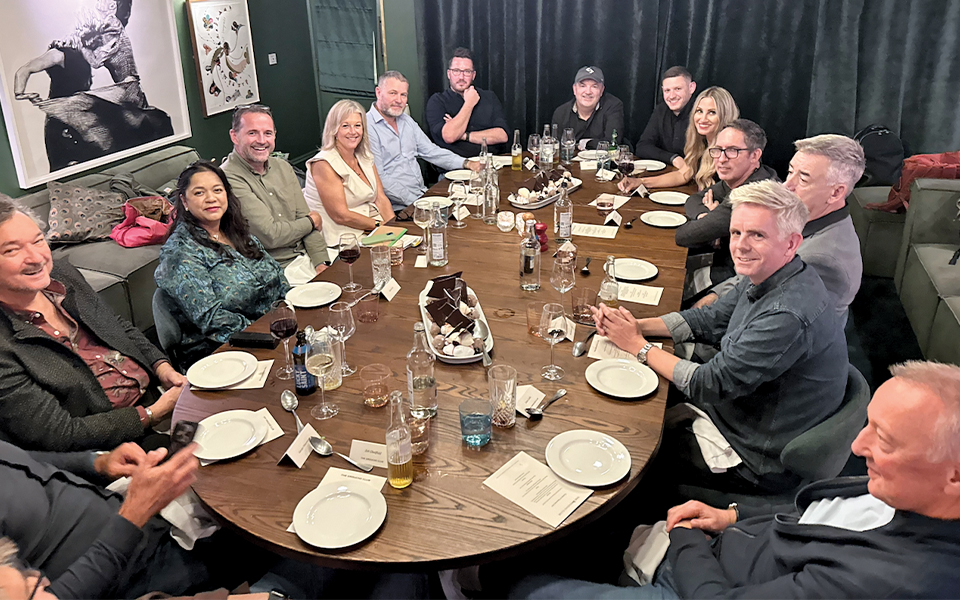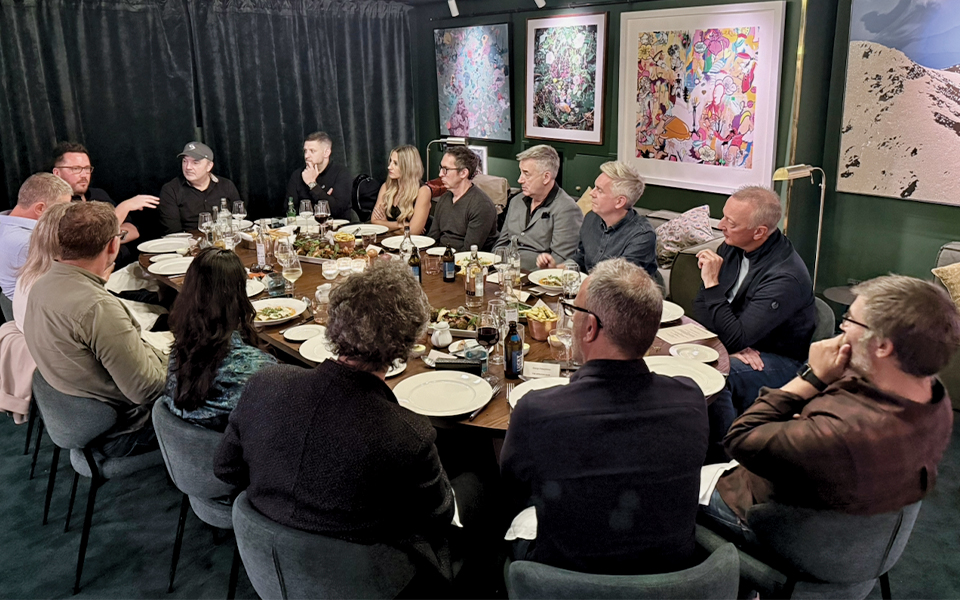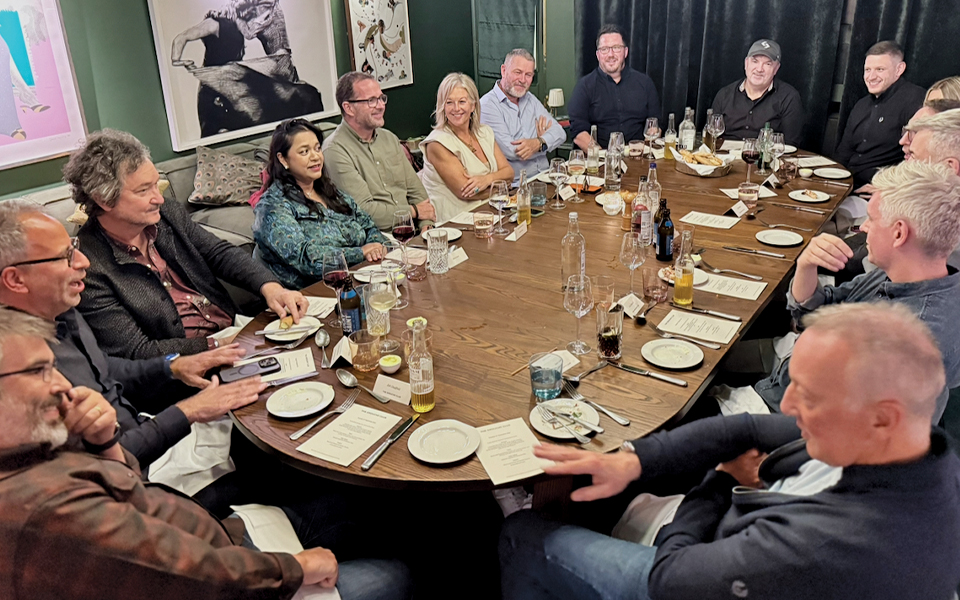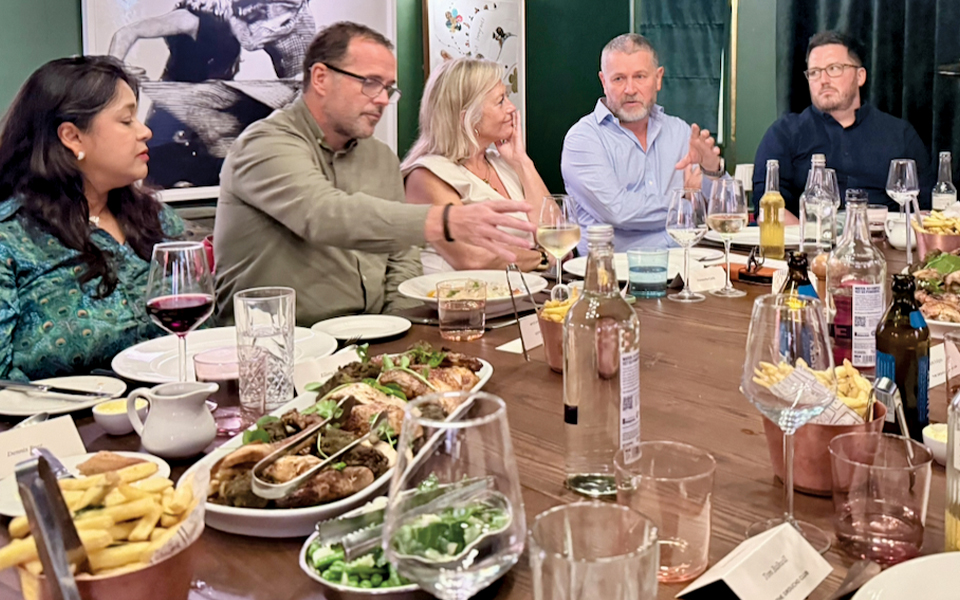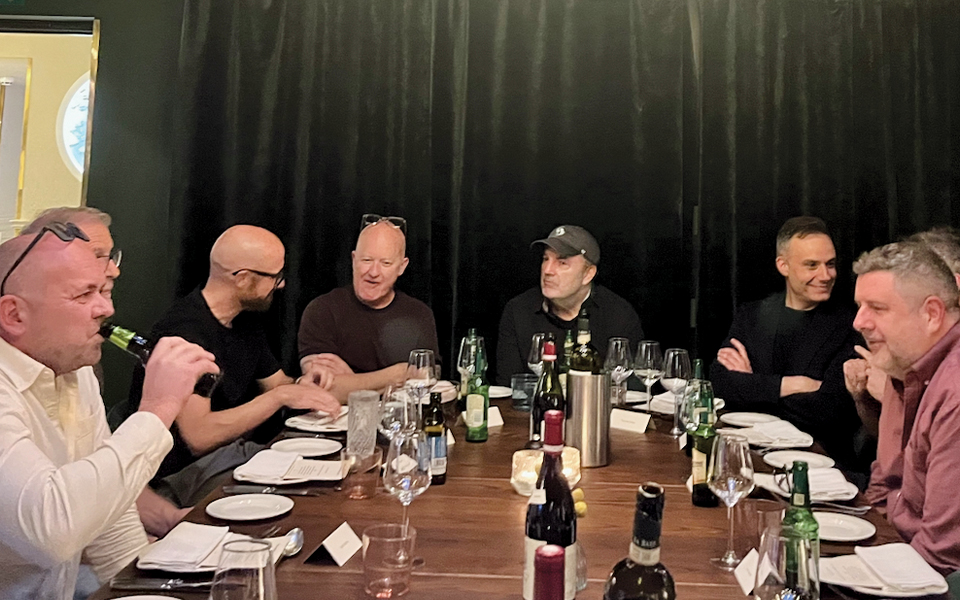

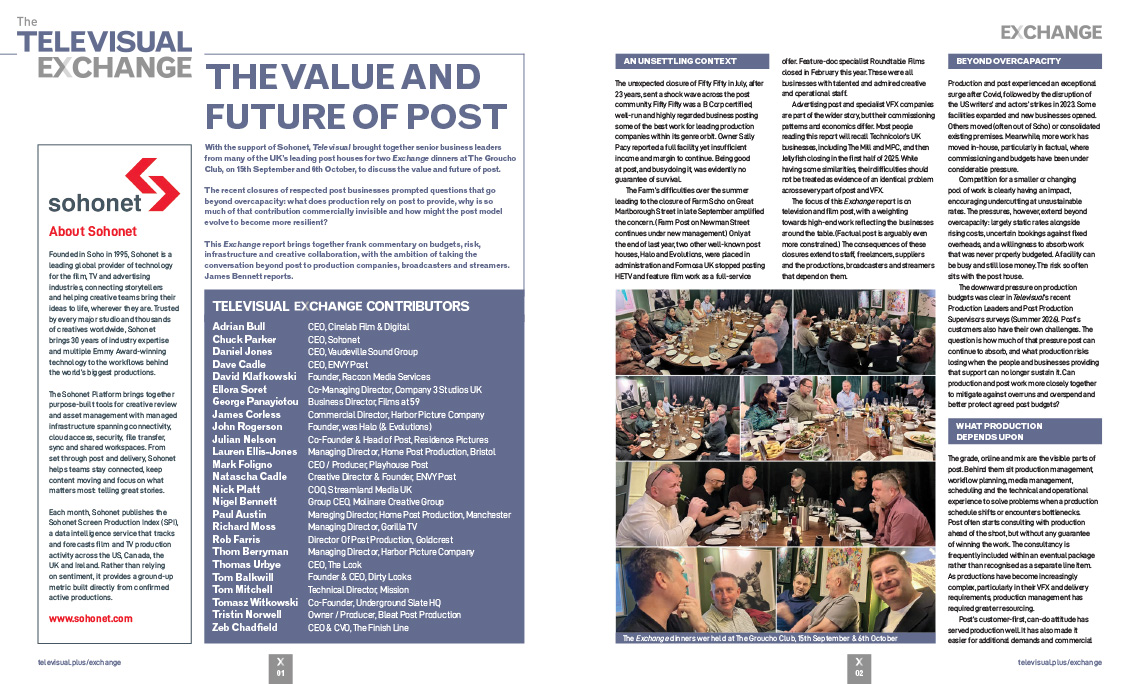
With the support of Sohonet, Televisual brought together senior business leaders from many of the UK’s leading post houses for two Exchange dinners at The Groucho Club, on 15th September and 6th October, to discuss the value and future of post.
The recent closures of respected post businesses prompted questions that go beyond overcapacity: what does production rely on post to provide, why is so much of that contribution commercially invisible and how might the post model evolve to become more resilient?
This Exchange report brings together frank commentary on budgets, risk, infrastructure and creative collaboration, with the ambition of taking the conversation beyond post to production companies, broadcasters and streamers. James Bennett reports.
An unsettling context
The unexpected closure of Fifty Fifty in July, after 23 years, sent a shock wave across the post community. Fifty Fifty was a B Corp certified, well-run and highly regarded business posting some of the best work for leading production companies within its genre orbit. Owner Sally Pacy reported a full facility, yet insufficient income and margin to continue. Being good at post, and busy doing it, was evidently no guarantee of survival.
The Farm’s difficulties over the summer leading to the closure of Farm Soho on Great Marlborough Street in late September amplified the concern. (Farm Post on Newman Street continues under new management.) Only at the end of last year, two other well-known post houses, Halo and Evolutions, were placed in administration and Formosa UK stopped posting HETV and feature film work as a full-service offer. Feature-doc specialist Roundtable Films closed in February this year. These were all businesses with talented and admired creative and operational staff.
Advertising post and specialist VFX companies are part of the wider story, but their commissioning patterns and economics differ. Most people reading this report will recall Technicolor’s UK businesses, including The Mill and MPC, and then Jellyfish closing in the first half of 2025. While having some similarities, their difficulties should not be treated as evidence of an identical problem across every part of post and VFX.
The focus of this Exchange report is on television and film post, with a weighting towards high-end work reflecting the businesses around the table. (Factual post is arguably even more constrained.) The consequences of these closures extend to staff, freelancers, suppliers and the productions, broadcasters and streamers that depend on them.
Beyond overcapacity
Production and post experienced an exceptional surge after Covid, followed by the disruption of the US writers’ and actors’ strikes in 2023. Some facilities expanded and new businesses opened. Others moved (often out of Soho) or consolidated existing premises. Meanwhile, more work has moved in-house, particularly in factual, where commissioning and budgets have been under considerable pressure.
Competition for a smaller or changing pool of work is clearly having an impact, encouraging undercutting at unsustainable rates. The pressures, however, extend beyond overcapacity: largely static rates alongside rising costs, uncertain bookings against fixed overheads, and a willingness to absorb work that was never properly budgeted. A facility can be busy and still lose money. The risk so often sits with the post house.
The downward pressure on production budgets was clear in Televisual’s recent Production Leaders and Post Production Supervisors surveys (Summer 2026). Post’s customers also have their own challenges. The question is how much of that pressure post can continue to absorb, and what production risks losing when the people and businesses providing that support can no longer sustain it. Can production and post work more closely together to mitigate against overruns and overspend and better protect agreed post budgets?
What production depends upon
The grade, online and mix are the visible parts of post. Behind them sit production management, workflow planning, media management, scheduling and the technical and operational experience to solve problems when a production schedule shifts or encounters bottlenecks. Post often starts consulting with production ahead of the shoot, but without any guarantee of winning the work. The consultancy is frequently included within an eventual package rather than recognised as a separate line item. As productions have become increasingly complex, particularly in their VFX and delivery requirements, production management has required greater resourcing.
Post’s customer-first, can-do attitude has served production well. It has also made it easier for additional demands and commercial risk to disappear into the service. The Exchange contributors question how bids describe their full contribution, who controls and protects the budget, and what should happen when confirmed work moves or simply evaporates.
There is no consensus that higher rates, better quoting or greater efficiency offer a magic bullet. The contributors also challenge their own costs and business models, while calling for clearer quoting and more formal booking arrangements.
UK Screen Alliance’s recent INsight conference addressed related questions, announcing a proposal for an expert group to develop a voluntary framework for requests for proposals, quotes and invoices. The objective would be clearer scoping and recognition of services, rather than setting rates. UK Screen’s agenda runs in parallel with the conversation over the following pages.
What should post become?
The report then turns to what a more sustainable business might look like. A new ‘hybrid’ model is explored, although contributors interpret it in different ways. Common themes include a smaller core of trusted people, changed locations and smaller client-facing premises, greater use of freelancers and remote working and more scalable infrastructure accessed or shared when required. What should a post house own? What work still needs a room for client-attended sessions and where should that room be?
Cloud-first workflows, automation and the MovieLabs 2030 Vision should offer reduced duplication and unnecessary work. They also raise questions about changed costs (both to production and to post), connectivity, limits of responsibility and how to support productions outside streamers’ or broadcasters’ proprietary systems, all with different requirements. Is a software-defined, cloud-first strategy based on distributed creative contributions always the most cost-efficient and creatively effective way to deliver productions?
Any future model must account for creative and technical collaboration, alongside better managed overheads, reduced commercial risk and how the next generation learns the craft. These considerations underpin the discussion of a more agile hybrid post model.
The contributions on the following pages offer extraordinarily frank commentary from people running these businesses. That conversation must now include production companies, broadcasters and streamers alongside post. All depend on the expertise post provides and all have a part to play in ensuring it remains capable of supporting their creative ambitions and delivering their productions.
What production buys from post
Rob Farris: Facility-based post is often discussed as just a series of creative sessions; “we are doing the grade/mix there”, and whilst those will always be the fundamental backbone of facility work, they’re only part of the service provided.
Mark Foligno: In reality, a good post house is a sophisticated problem-solving business, a consultancy of creatives and technicians.
Lauren Ellis-Jones: Much of post’s contribution happens outside the booked creative sessions: planning workflows, managing media, adapting schedules, troubleshooting and making sure programmes meet delivery requirements. That expertise gives production confidence and continuity, but the time and resources behind it are not always recognised in the budget.
Zeb Chadfield: Post production work is best when you can’t see it. The downside is it starts to look simple, and that undersells the complexity and the talent it takes to provide the services at that level. For most production companies the volume of work isn’t there to make doing it internally viable.
Dave Cadle: The operational demands have changed enormously. We are expected to organise multiple facilities and entire teams of highly skilled people simultaneously and most of the time at short notice.
Paul Austin: We have noticed that there is a growing reliance on our post producers to do more and more of the work. This role is essential to the smooth running of a project, and post producers are often the ones with the biggest overview of every element of the delivery, but none of what they do is charged for.
Richard Moss: Post-production is full of decisions that sit between technology and creativity. A technically correct answer may be financially unrealistic. A lower-cost choice may threaten delivery or quality. A faster workflow may reduce the opportunity for creative review. Specialist post teams understand these tensions and help production make informed decisions. The value is not that a post house prevents every problem. It is that the production does not face those problems alone.
David Klafkowski: Post also acts as a kind of production insurance policy. Schedules move, briefs change, media turns up late, deliverables change, something breaks elsewhere in the chain and post absorbs a huge amount of that complexity and keeps the programme moving. That is often where the real value sits, and it is often the least visible part of the bid.
Fail to plan…
David Klafkowski: Post has become less obviously “post”. The involvement of a good post partner has moved much further up the production supply chain. Workflow, media strategy, security, collaboration, storage, remote access and delivery planning are increasingly decisions that need to be made before the shoot, not after it.
Rob Farris: Well-run productions invariably include a workflow call covering Dailies/DI/Delivery before shoot starts, proving the importance post plays in any show. Much of the workflow discussed will be designed/controlled by the post facility and it will likely be tested within the first week of shoot to validate the processes used on set.
Good facilities save productions money by designing efficient workflows, avoiding rework, overcoming and reducing technical issues and getting delivery right.
Tristin Norwell: Recently, we have had the opportunity to engage with producers and production companies earlier (often before a project is greenlit and before a PPS is appointed), and this gives us an opportunity to set, or at least advise/educate on the post budget.
Thomas Urbye: The current model works well when productions and post companies agree the scope, schedule and responsibilities early, with enough flexibility to accommodate creative changes. I would like to see post producers/supers set out how many hours they want for grading, Flame/Online and the exact deliverables in more detail, rather than just sending, ‘can you give me a quote for a six-part drama for a major streamer’. Too often enquiries provide little more information than that. Sometimes you’re negotiating with a line producer who has little experience of post production and just wants to know the total cost of your proposed services. For post supervisors to compare quotes more easily during quoting, we all need to work within a common framework, regardless of the rates we all charge.
Lauren Ellis-Jones: As post businesses, we have a responsibility to improve how we work and offer clear, demonstrable value. In return, we need earlier involvement in budgeting, realistic scopes and a fair process for managing changes.
Thom Berryman: The days when a facility could routinely absorb project setup costs and additional ‘small asks’ have passed.
Budgets and the limits of efficiency
Lauren Ellis-Jones: Our clients are struggling to make the same calibre of programmes with the budgets available to them. But there is a limit to how much can be achieved through efficiencies without compromising quality or the people delivering it.
Above all, broadcasters, streamers and commissioning decision makers need to set budgets that reflect their expectations.
Innovation can help us work better. Realistic funding makes that progress sustainable.
Mark Foligno: I understand the pressure on production budgets because I am also a producer. But squeezing post-production margins to the point where businesses cannot reinvest in people or infrastructure is ultimately self-defeating.
Thom Berryman: But understanding the value does not always give our immediate clients control over the budget. They may inherit a budget agreed before they joined the production, or work within a studio allocation that does not adequately account for the true cost of post.
Adrian Bull: The biggest challenge is that rates haven’t meaningfully changed in over 20 years and costs over the past 5 years have risen significantly.
Tristin Norwell: Post, as the last step in the process, is most at risk of being squeezed down. And unlike production crew and cast, there is often little pushback from the post sector to maintain rates and say ‘no’.
Can higher rates repair the business model?
Tom Mitchell: Post won’t rescue its margins by charging more. The reality is that its clients now buy from a global market of very good, very competitive companies, and they’re competing for viewing hours themselves, against content made for a fraction of their budgets.
Waiting for rates to rise is a route to nowhere. The better route is finding ways to save money.
John Rogerson: I’m wary of any argument that assumes our customers should pay more simply because our cost model is no longer fit for purpose. Before asking production to fix our economics we, as an industry, have to examine our own.
Zeb Chadfield: The nature of the industry has held rates in an unsustainable place for a long time. We’ve been fortunate enough to innovate our way through it and stay afloat by embracing new technology and finding new efficiencies, but I can see the room to innovate shrinking and the cost of developing and supporting new systems along with security needs increasing.
Protecting the agreed post budget
George Panayiotou: Most production companies are in overspend by the time they reach post and assume that post houses will absorb a percentage of their overruns. This is not sustainable and production companies needs to recognise the importance of ring-fencing their post budget.
Julian Nelson: Budgets would be better protected if deliverables and the post budget were fully agreed upstream, with a defined contingency line for creative change. That contingency should be held by whoever owns the IP and controls the schedule, which is usually the commissioner or studio; it should not be absorbed by production and then ultimately the post house.
Pricing the services each production requires
David Klafkowski: If we keep giving complicated things away for free, we shouldn’t be surprised when clients start to think they’re free.
John Rogerson: We quote the edit, grade, online and mix because they fit neatly on a rate card. Workflow design, technical consultancy, media management, security, scheduling and troubleshooting too often disappear into the package. Then we describe the people doing that work as “non-revenue-generating” – but if we make that expertise commercially invisible ourselves, we can hardly be surprised when it becomes invisible to the customer. Post-production doesn’t necessarily have a problem delivering value. It has a problem capturing the value it delivers. It must become better at allocating and recovering its costs within the budgets that actually exist, rather than assuming additional money will materialise.
George Panayiotou: As a post house, we accept that we need to provide support to production teams in the form of post producers, workflow teams and tech support. Although these services are charged as individual lines in our quotes, the cost to us has to be reflected in our hourly rates.
Tristin Norwell: Quotes should list all services (including the myriad invisible and currently uncharged ones), and all services should show a proper ‘book rate’. Even if the book rate is then discounted, at least clients can see the real value of the services.
Thom Berryman: The relationship between billable time and underlying costs also varies considerably. A shorter project with complex requirements can need substantial preparation and coordination. Investment behind the scenes can make the grade or mix faster, reducing billable time without reducing the cost of delivering it. When schedules compress or deliveries change, the unbillable support required will increase.
But it cuts both ways. Simply increasing creative or attended hourly rates could disproportionately charge productions needing longer sessions. More creative time does not necessarily mean a corresponding increase in support or infrastructure requirements.
The model needs to reflect the processes, people and infrastructure each production actually requires.
When flexibility becomes a commercial risk
Nick Platt: Ultimately, it is post companies that take on the commercial risk of keeping the finishing element of the industry operational, and clients rely on us for that very reason. They don’t need a facility 24/7, they want to be able to dip in and out as their projects require.
Thomas Urbye: The difficulty also comes later when flexibility becomes one-sided. Projects regularly move, requirements change and increasingly bookings can be postponed or cancelled with little financial consequence for the production. We end up significantly out of pocket if we turn away a project because the initial production insists on first pencils or threatens to pull the project.
Dave Cadle: The responsibility doesn’t just sit with the post houses alone. Broadcasters, commissioners and production companies need to recognise the impact of the way work is now awarded. Our capacity doesn’t appear overnight. It requires significant investment in technology, infrastructure and people. Those costs exist whether a production is confirmed on time or delayed. Yet post houses are frequently expected to absorb that uncertainty while continuing to compete on increasingly tight margins. That simply cannot continue indefinitely.
Richard Moss: The difficulty is being expected to reserve people, technology and capacity, then absorb every cancellation, delay and additional requirement as though those resources cost nothing. No sustainable business can operate indefinitely on that basis.
Paul Austin: We all have cancellation policies, but it is often felt that if these were implemented, that client might not choose to work with you again, as other companies would not pass these on. It is hard to think of another industry in which this happens.
Mark Foligno: Creative changes will of course always happen, but those changes need to have a commercial consequence.
Dave Cadle: Too often the deciding factor has become price rather than value, expertise or the ability to deliver. Winning work at any price is not a business strategy and the continual race to the bottom has damaged the industry.
Tristin Norwell: Each service rate needs to be ‘sustainable’ in its own right. For example, cutting rooms shouldn’t be seen as a loss leader in order to win the finishing post; cutting rooms need to be properly costed out and ‘wash their face’ with redundancy factored in.
Richard Moss: A healthier model requires honest scoping, clearer contracts, fair cancellation terms and shared responsibility when requirements change.
John Rogerson: The balance of power between customer and supplier is all out of kilter, largely because the post industry’s collective behaviour is perpetuating its own problems. And this isn’t necessarily because clients are behaving unreasonably. Too often, we’ve surrendered our own commercial leverage through fear that, if we push back, the work will simply go elsewhere. Absorbing stretched deadlines, changing schedules and requirements, inaccurate briefs and unrealistic expectations – often pushing our staff to their limits and beyond – has become accepted as part of the job.
But it costs real money. Ignoring those costs while congratulating ourselves that ‘it’s just what post does’ is one of the reasons we’ve ended up in such a commercially weak position.
Business failures put capacity and expertise at risk
Paul Austin: This is a critical ‘adapt or die’ time for the post-production and wider broadcast industry, which has unfortunately become inevitable due to many decades of rising costs, static rates and a turbulent market.
Dave Cadle: We need a more honest conversation about administration and pre-pack arrangements. Having been involved in difficult business decisions ourselves, I recognise that administration can sometimes be unavoidable. But the wider industry must question a commercial environment in which businesses can accumulate substantial debts, collapse and re-emerge.
David Klafkowski: That practice has distorted the market in recent years. A supplier that cannot sustainably deliver what it has sold is not offering good value just because the quote looked cheap.
Dave Cadle: We, as post houses, need to understand our numbers, protect our margins and stop accepting work at prices that cannot sustain the facilities and people required to deliver it. Equally, broadcasters and production companies need to recognise that continually driving down costs ultimately threatens the quality, choice and expertise they depend upon.
Thomas Urbye: If we unintentionally remove too much capacity from the market today, production companies and streamers may find themselves with far less choice, considerably higher costs and delivery risk to their projects tomorrow.
The cost of the building
John Rogerson: Post exposes itself to horrendous fixed cost risks… if you have ten or fifteen years of contracted, committed work that comfortably supports a ten or fifteen-year lease, go for it. But signing that lease and then fighting for piecemeal work year by year, against a piranha tank of struggling competitors prepared to undercut you, is a very risky proposition. Today’s dominant player can face a very different market in three or five years. A new competitor, a change in commissioning, the loss of key talent or a different way of delivering post can overturn its advantage… but the lease remains.
Adrian Bull: The amount of client-attended time in creative finishing has reduced as the burden passes to post and the pressure on production budgets means they often don’t justify the attendance time. This leaves traditional post with the legacy of large costly environments that are underutilised and a lot of the time only used by the facility staff. I would expect client-attended time in picture and sound finishing is well under 50%. This opens up the opportunity for lower cost competition without the need for a Soho base.
Nick Platt: I think all businesses are struggling with the rising cost of real estate so there is certainly an argument for smaller client-facing space in central London with unattended space either on the outskirts or remote.
Paul Austin: We are luckier in the regions that square footage is moderately cheaper but there is also an expectation that things should be cheaper overall in the regions, so similar margin pressure points are faced.
The rise of cloud-based remote workflows is a positive thing, one we have fully embraced, but it can only be fully felt on a financial basis once leases end, or are reduced, which may be several years away for many traditional post facilities.
What a hybrid post house might look like
David Klafkowski: I don’t think the future is about defending the traditional post-house model. It is about protecting the things post does incredibly well – creative talent, technical expertise, workflow knowledge, problem-solving, flexibility and service – while accepting radical change in the business model and infrastructure underneath it.
Thomas Urbye: I see three possible outcomes: a fragmented market of freelance teams working predominantly in the cloud and being hired directly by the post super/production company/streamer perhaps using short-lease serviced offices; or a hybrid model combining technology with established post expertise in post houses; or significant consolidation. Perhaps the ultimate outcome is a market dominated by one or two major groups as facilities become economically unsustainable. For me, the hybrid model presents the greatest opportunity for all parties.
Nigel Bennett: At Molinare Creative Group, we are responding by moving away from the traditional post-house model towards a more diversified, integrated creative and technology business. Our focus is on connecting services across the production lifecycle, reducing duplicated infrastructure, investing in automation and developing new revenue streams beyond traditional film and television.
I believe the future is a hybrid model. Cloud technology and distributed working offer enormous opportunities, but they are not a universal solution. Creative collaboration, technical expertise, security, resilience and the ability to solve problems remain essential. The right balance between physical facilities, shared infrastructure and cloud-based services will depend on the production.
Rob Farris: The conversation about the future will be most successful when it isn’t framed as “traditional post vs MovieLabs/AI”. The most successful facilities over the next few years will combine the best of each. Cloud where it’s genuinely better, physical spaces where they still matter. Distributed talent where location isn’t relevant, centralised teams where collaboration counts. Using AI to take away low-value tasks and human judgement where it makes the difference.
David Klafkowski: The question we are asking is: what do we actually need to own? The things you can genuinely sweat over a long period are often the very physical things – good rooms, desks, monitors, furniture, peripherals. A lot of the traditional technical infrastructure is much harder to think of as a long-term asset now. Software manufacturers have already made sure much of what used to feel like CapEx is really OpEx. Storage and compute are heading the same way. I’ve always used the slightly flippant line that storage is either critically full, brand new, or you’ve bought too much of it.
Keep a core permanent team of the very best creative, production, technical and support people – the people who define the quality, culture and knowledge of the business – and ensure you have a crack sales team out there to keep them busy. Then burst with the best freelance talent the production can afford when demand requires it.
Julian Nelson: I’d start with what to keep. That means a lovely building in a convenient location that folks want to be in, with calibrated rooms and senior expertise. Post will remain accountable for the final image and maintain a dedicated training pipeline. I would also have a private data centre that is “studio ready” so one can easily spin up deployed machines or work on owned kit and burst when we need to. We should aim to stop duplicating storage and transfers that a shared cloud model could remove.
John Rogerson: Start with the production’s requirements and assemble the operation around them: a facility, a temporary creative hub, distributed contributors or a supported environment within the production company itself. With so much outstanding creative talent now working independently, it’s possible to assemble exceptional teams around individual productions without requiring those people to be permanently attached to a particular facility. The commercial proposition shifts from selling access to the resources we happen to own, towards taking responsibility for assembling and managing the resources a production actually needs.
Daniel Jones: For the last twenty years, Vaudeville’s model has been built on watching what production companies do when they get a commission: they crew up, scale up, deliver the project, then scale back down. We’ve mirrored that, including by embedding our teams within production companies. It’s the post producers, the schedulers and the management behind every daily activity that make it work. We still have core facilities, staff and management, as any business needs, but our strength is flexibility, scalability, and putting the right people on the right job once it’s green-lit.
The real value of being embedded isn’t the cost saving, although it can be one. It’s being involved from pre-production. Because we’re physically on site, we join the start-up meetings, and we always insist on attending. That gives us a thorough understanding of the ambition of the project. And when post is discussed up front, there’s usually a proper budget allocation for it, especially audio. When it isn’t, the money has normally run out before it reaches us.
So, my view is that the future lies in bringing production and post even closer together. We see this in gaming, where the platform and the game are built side by side with constant back and forth, and we’ve found the same in animation.
Richard Moss: If I were building a post business for the next few years, I would not judge its strength by the number of rooms or machines it owned. I would judge it by the quality of its people, the trust it has earned, how quickly it can adapt and whether it is prepared to take responsibility for the finished programme. Technology will change rapidly, but those are the things clients will continue to pay for.
When streamers provide the infrastructure, who pays and who’s responsible?
Thomas Urbye: The MovieLabs 2030 Vision provides an important technological direction, and The Look is already testing and embracing these workflows. The cloud offers genuine opportunities for efficiency, flexibility and collaboration, but technology alone doesn’t replace the creative environments, trust, technical expertise and wraparound care required for feature films and high-end drama.
Julian Nelson: I am optimistic about the cloud; it means a single source of truth for media and metadata, efficient security and auditability, global collaboration and less duplicated storage and transfer. I believe this is the future and something to strive towards. Post should be helping to build towards these goals rather than resisting them.
Adrian Bull: We should be wary of large cloud providers trying to control this space – the erosion of experience and understanding could happen very quickly as I don’t believe there is a mechanism for this model to support the experience that post facilities have. It would be good to see a collaborative cloud model specific to the industry. I completely agree with the benefit of a common storage platform serving the interaction of multiple vendors, but it would be good if it was owned by the facilities.
David Klafkowski: We are also seeing streamers looking to own and centralise storage and compute across productions. I don’t see this as a threat in itself. If they take on infrastructure that the facility would previously have provided, then yes, the facility’s top-line billing should come down. But our real costs have to come down too. Everyone needs to be very clear about where the responsibilities now sit and what services the post company is still providing around that infrastructure.
Julian Nelson: When a studio provides cloud storage, a central asset system or deployed machines, it removes a cost from the post house, but it doesn’t remove the work. Someone still has to manage onboarding, ingest, conform etc. from cloud-hosted media, meet that platform’s security requirements, and learn a different environment on every show. I believe the cost moves rather than disappears and post houses should be united on what these line items now are.
Tom Balkwill: Studios are increasingly asking us to remove traditional line items from post vendors’ quotes (as they now intend to provide these services themselves and, in the future, recharge productions for them), focusing instead on what the streamers don’t have in-house: post industry-specific expertise, creative talent and calibrated picture and sound finishing rooms, for example.
Running streamer and non-streamer workflows in parallel
Tom Balkwill: This split in workflows effectively means we need to retain ‘legacy’ storage and on-premises hardware for some projects, while no longer being able to recover these capital investments through many of our cloud-led projects.
Inevitably, on-premises projects end up becoming more expensive.
Zeb Chadfield: If anything, supporting someone else’s infrastructure would cost more, because we didn’t design it and we don’t control it. There’s also a big question around where responsibility sits, and who bears the cost when it falls over when you’re up against delivery.
Nick Platt: The alternative, of course, is that streamers run their own post services, and despite some workflows being taken in-house already, on a commercial basis I believe that for most it is better to rely on the flexibility of vendors rather than running a cash-heavy operation themselves.
Adrian Bull: Ultimately, if services migrate to a utility cloud-based approach, then it will likely favour a freelance operational model. The risk to the client is the lack of technical expertise around this model to support what have become much more complex workflows.
Tom Mitchell: The cloud question isn’t either/or. Renting edit workstations in the cloud full-time is usually dearer than owning them. Where the media already sits in the cloud, though, an automated process running in parallel for an hour, rather than a machine and an operator for a whole day, is a different sum: dearer per hour, far fewer hours. Working remotely doesn’t have to mean a hyperscaler. An editor at home can work on a facility’s own kit.
Grading theatres and mix stages belong on-prem, with only the media they need held locally. With a client in the room and a deadline looming, you can’t afford a dropped connection stalling the session.
A shared and scalable infrastructure model
Tom Balkwill: But is it an efficient use of UK post houses’ engineering time for each company to be developing its own tools to manage these cloud-like processes on its own hardware? Or is there an opportunity to share some of these tools, running them on sovereign, UK-hosted ‘private cloud’ infrastructure, where we can manage our own projects, workflows and workloads, while monitoring their environmental impact?
Crucially, this could also give us greater control over data egress costs, avoiding the disproportionate expense of moving terabytes of data in and out of typical cloud infrastructure.
Tom Witkowski: My vision is a cooperative post-production facility: a creative city where independent boutique companies retain their own brands, clients, pricing, talent and creative identities, but share expensive infrastructure.
Importantly, the cooperative would be operated by an independent body responsible for infrastructure, investment, technology, security and fair access.
The cooperative model is not about reducing the value or price of post-production services. It is about reducing duplicated infrastructure costs, improving utilisation and allowing independent businesses to compete on creativity rather than capital investment.
My conclusion is simple: share infrastructure, not identity. Standardise workflows, not creativity. Automate repetitive processes, not human judgement.
Automating processes while protecting creative judgement
Tom Mitchell: In my experience, perhaps three or four in ten people in a post house are directly billable. The rest do the work nobody sees and no show can skip: moving media, checking it, preparing it, reconciling versions, chasing vendors. Much of that is still done by hand, and that’s where the cost sits, in the manual process, not the people doing it.
If I were building a post business now, I’d own the core and flex the rest. Own the people who hold the judgement and the client relationship, and the rooms that really have to be rooms. Flex capacity for the peaks. Automate the handoffs, so a show’s context travels with its media instead of being rebuilt at every vendor. That’s how post can offer production better value without cutting creative rates.
Mark Foligno: At Playhouse Post, working alongside HYRON AI, we are already exploring and implementing how AI can improve everything from script development to script breakdowns, reference materials and VFX planning to shot management, asset creation and post-production workflows.
Richard Moss: AI can support edit prep, transcription, logging, search, versioning and other repetitive tasks. Post companies should help productions use it responsibly by protecting content, understanding rights, checking outputs and applying human judgement.
Rob Farris: The future isn’t less post. It’s post organised more intelligently, with people as the layer of expertise on top of increasingly automated infrastructure.
Collaboration, training and what comes next
Julian Nelson: The DP, showrunner and execs still want to attend in person. There is no substitute for a colourist reading stakeholders’ reactions in the room; this is part of how decisions get made.
David Klafkowski: Physical space still matters enormously for creative chemistry, collaboration, client experience, training younger people and all those moments where being together simply makes the work better. But there is no sensible reason every person, machine or piece of media has to sit under the same roof all the time.
Paul Austin: We work on many big, scripted shows, where production teams want to be in the room with our creatives and the best possible monitoring. We also work on larger scale ob-doc unscripted series, that can have a large number of edits running together, where collaboration and flexibility are key. The real value is trusted support, reliable infrastructure, and the ability to have true human connection to enable true creative content.
Natascha Cadle: Of course we need to embrace AI, cloud technology and more flexible working, but we shouldn’t underestimate the value of people learning alongside each other, sharing knowledge and building relationships.
I set up the ENVY Academy nearly 20 years ago because we needed to develop our own talent. Now about two-thirds of our staff have come through the runner route. We offer up to 150 work experience placements a year, which we are incredibly proud of, but it takes time, money and commitment. If we lose the businesses that invest in young people, where will our future editors, colourists, mixers and producers come from? I think we’re in danger of solving today’s margin problem by creating tomorrow’s talent problem. If broadcasters and streamers continue to squeeze post budgets while benefiting from the talent we develop, then who is going to pay to train the next generation?
George Panayiotou: If we are pushed to reduce our rates, we are not able to sustain the numbers in these teams and we risk losing the knowledge and experience that is so beneficial to production.
Julian Nelson: Many of the tasks AI will automate are the ones junior staff currently learn on, so we need to design new ways of training people. Assistants learn through osmosis, by being next to experienced artists, hearing the conversations and seeing how problems get solved. A fully distributed model risks a generation that never gets that, along with folks who feel disconnected from the work and from each other.
TAKING THE CONVERSATION TO PRODUCTION, BROADCASTERS AND STREAMERS
Dave Cadle: The future of post-production must be built around financially sustainable businesses that can invest, adapt and deliver without constantly compromising their commercial viability.
Lauren Ellis-Jones: Remote working and cloud-based solutions can offer flexibility and cost savings where they suit the production. They should be part of our evolution, alongside shared infrastructure and better collaboration. However, they still require skilled people, technical support and careful management. They cannot close every gap between the programme being commissioned and the budget available to make it.
Thomas Urbye: Post companies need to evolve, become more transparent about their value and embrace technology where it genuinely improves the production process. In return, we need studios, streamers and producers to recognise and support the people and infrastructure on which they continue to depend.
The biggest question is whether we can collectively develop a commercial model that supports the entire ecosystem. I think that needs to be led by the streamers
and broadcasters.
Nigel Bennett: Post needs to be involved earlier, budgets need greater protection, and risk must be shared more fairly.
Ultimately, this is not about protecting the old post-production model. It is about creating a more efficient, collaborative and financially sustainable industry that delivers better outcomes for everyone.
Quo Vadis, post?
Chuck Parker: Three Exchanges, 34 people who run UK post, and one surprise: the volume of work isn’t the main problem.
The UK is the one region still running above its pre-strike level of production, at 109% of 2022 through September on the Sohonet Screen Production Index. If volume were the main driver of vendor stability, high-end UK post would be thriving.
What’s hurting is the bundle coming apart. For thirty years a post house sold a “wrapped service” at one rate: craft talent, a purpose-built facility, conform, asset management and project wrangling. Clients are now trying to buy those pieces one at a time, and the parts that carried the margin are being competed away or never charged. A house with a long lease and a capital plan can’t re-price as fast as the work is being unbundled. So, it prices to cover the week’s costs, stays busy, and still can’t pay for the building.
Some operators have gone hybrid, taking on more of the work around post in one of three ways. They’ve built elastic: a small, owned core that scales out and back. They’ve moved towards production: picking up production services and sometimes financing, where they control more of the budget. Or they’ve moved towards visual effects: taking on shot generation and clean-up work, which is brutally competitive but growing. Views differed on higher rates, but clearer line items matter: making the invisible work visible to the client.
Where I think this could land within two to three years is a handful of very large post groups serving the biggest features and premium series (budgets of $35m and up), and a long tail of hybrid boutiques doing everything else (where the growth is likely to come from). Those in the middle face the challenge of adapting stranded costs. And if growth is moving towards visual effects, the next Exchange should bring VFX leaders into the room.
These reflections build on conversations with colleagues around one table over three dinners, saying what they’d usually keep to themselves. The next step is carrying that conversation to the independent producers and studios who commission the work.
Many thanks to Sohonet for supporting the Exchange dinners and this report.