
Televisual invited leading corporate producers to discuss how their role is changing at a time of growing demand for video content, digital campaigns and live events
The sector comes of age
The corporate production sector has had its ups and downs over the past decade.
It had prospered as brands and governments spent big on films for staff, customers and shareholders. But the 2008 economic crisis brought cuts in client budgets. Digital disruption meant new players – ad agencies, videographers or brands’ in-house teams – joined the fray. The heads of corporate production companies battled to adapt.
Yet the mood at the 2019 Televisual Corporate roundtable was different. Most production heads agreed there is “plenty of work out there.” There is more confidence that clients need the skills that corporate producers offer, and that ad agencies are recognising that corporate film is best delivered by specialists. It’s a sector that has found its place in brand communications.
There’s more than one way to succeed in brand film production. Televisual asked the industry’s leading production companies how they do it.
The full service approach
Some producers took the strategic decision to expand from specialising in film and video. It’s a strategy that has spawned some fast-growing businesses with roots in corporate film. Producers either need to scale up their in-house resources for digital campaigns and live events, or assemble a network of partners.
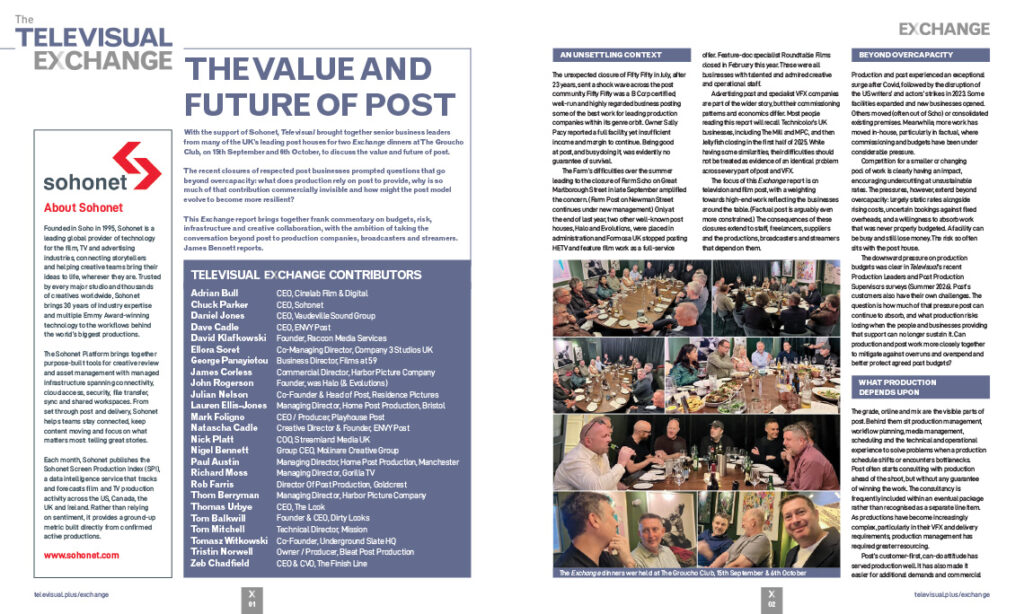
Dagmar Mackett of DRPG, which was rated 1st in this year’s Televisual Corporate 50, said it now describes itself as a creative communication agency. “Clients need help with communications campaigns, not events, films or websites. We have restructured the team and how we work to reflect how things have changed.”
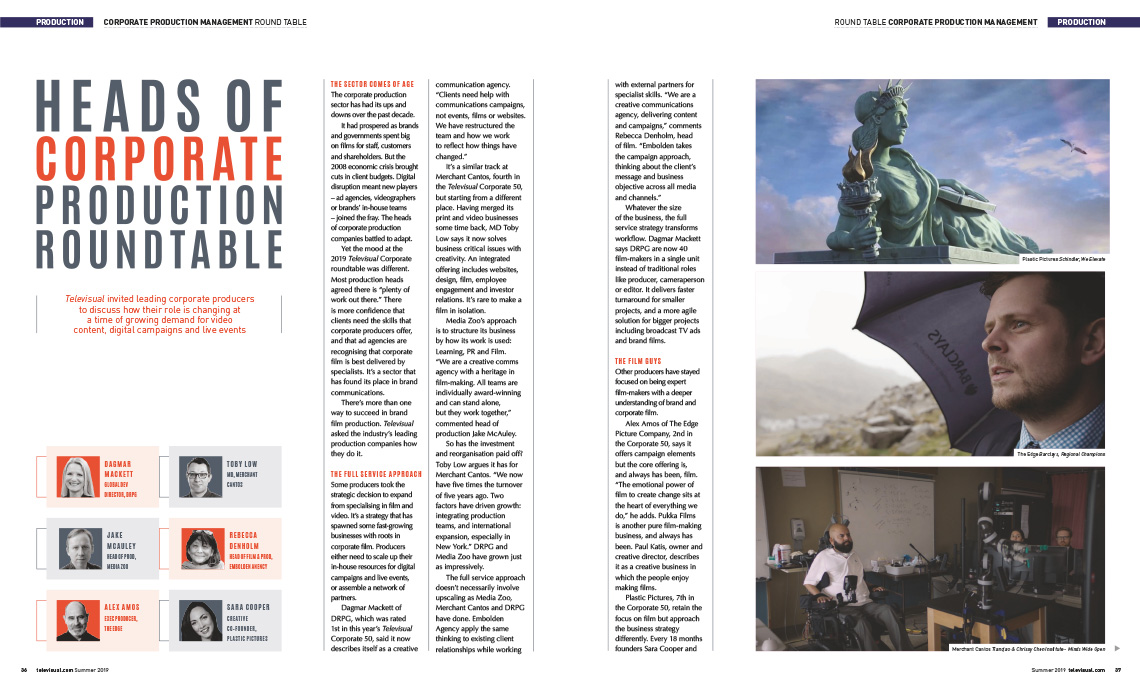
It’s a similar track at Merchant Cantos, fourth in the Televisual Corporate 50, but starting from a different place. Having merged its print and video businesses some time back, MD Toby Low says it now solves business critical issues with creativity. An integrated offering includes websites, design, film, employee engagement and investor relations. It’s rare to make a film in isolation.
Media Zoo’s approach is to structure its business by how its work is used: Learning, PR and Film. “We are a creative comms agency with a heritage in film-making. All teams are individually award-winning and can stand alone, but they work together,” commented head of production Jake McAuley.
So has the investment and reorganisation paid off? Toby Low argues it has for Merchant Cantos. “We now have five times the turnover of five years ago. Two factors have driven growth: integrating production teams, and international expansion, especially in New York.” DRPG and Media Zoo have grown just as impressively.
The full service approach doesn’t necessarily involve upscaling as Media Zoo, Merchant Cantos and DRPG have done. Embolden Agency apply the same thinking to existing client relationships while working with external partners for specialist skills. “We are a creative communications agency, delivering content and campaigns,” comments Rebecca Denholm, head of film. “Embolden takes the campaign approach, thinking about the client’s message and business objective across all media and channels.”
Whatever the size of the business, the full service strategy transforms workflow. Dagmar Mackett says DRPG are now 40 film-makers in a single unit instead of traditional roles like producer, cameraperson or editor. It delivers faster turnaround for smaller projects, and a more agile solution for bigger projects including broadcast TV ads and brand films.
The film guys
Other producers have stayed focused on being expert film-makers with a deeper understanding of brand and corporate film.
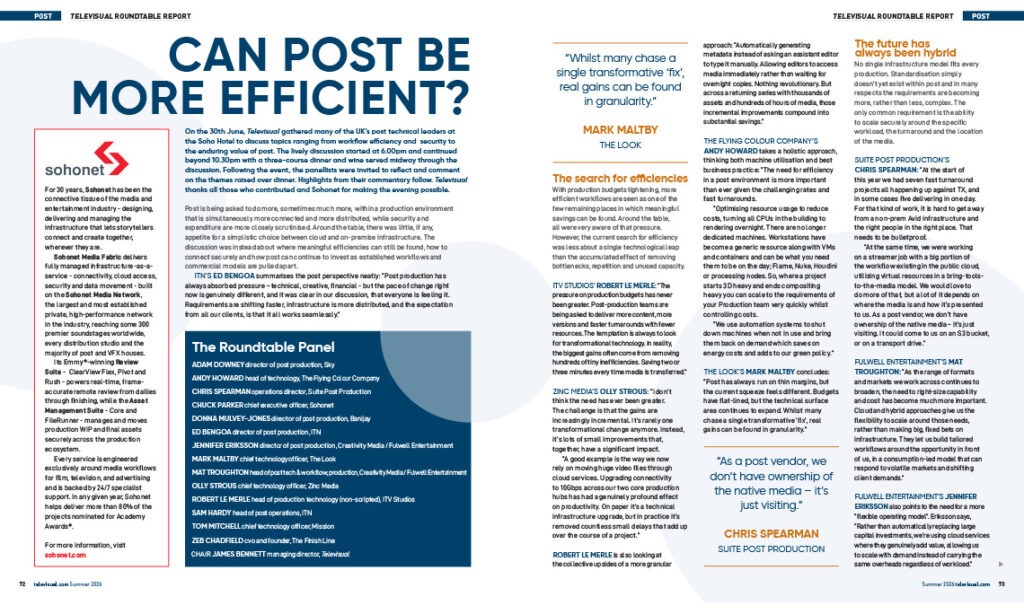
Alex Amos of The Edge Picture Company, 2nd in the Corporate 50, says it offers campaign elements but the core offering is, and always has been, film. “The emotional power of film to create change sits at the heart of everything we do,” he adds. Pukka Films is another pure film-making business, and always has been. Paul Katis, owner and creative director, describes it as a creative business in which the people enjoy making films.
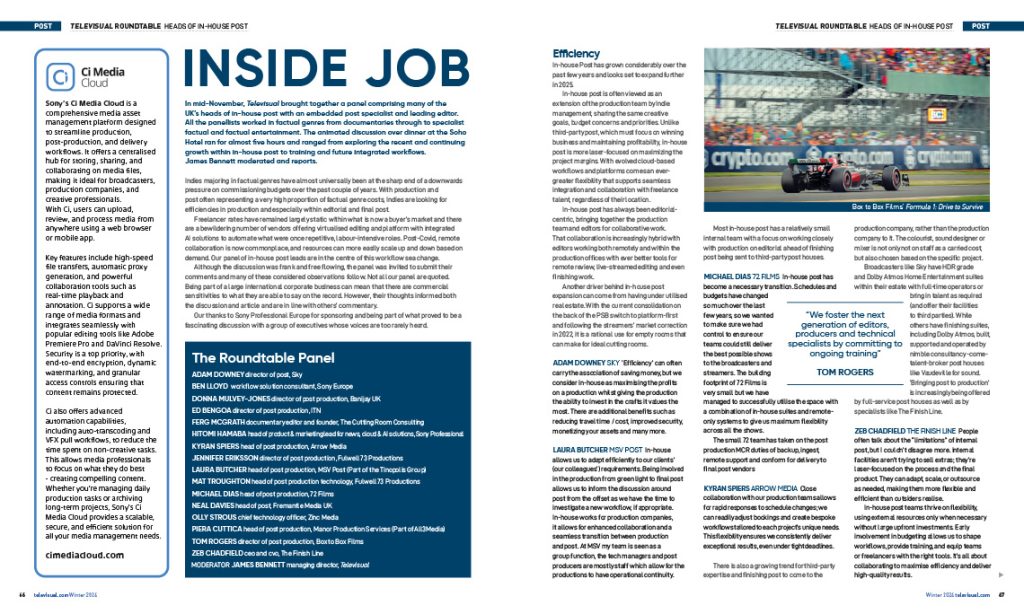
Plastic Pictures, 7th in the Corporate 50, retain the focus on film but approach the business strategy differently. Every 18 months founders Sara Cooper and James Dark re-invent the business as new technology emerges and opportunities arise. They remain a creative production agency, but the focus is on building a place where people love coming to work. It means they can attract the talent they want, like Scott Livingstone, the creative director Amazon UK who joined the Plastic team.
8th-placed Casual Films has pivoted back to being a production company and away from the agency style it developed a couple of years ago, according to MD Oliver Atkinson. ‘We are filmmakers first and foremost, and video production consultants.’ It finds jobs are getting both bigger and smaller, and it produces wider campaigns as well as more targeted projects.
The producers agreed they are seeing a revaluation of brand film production expertise among commissioners. Brands’ video output has grown hugely, but not always with a full understanding of the need for authenticity and compelling storytelling. With video content swamping our digital devices, the need to engage the audience deeply is better understood.
OK but…
It’s never all roses in the brand film garden, so we asked the production heads what keeps them awake at night. The responses were more diverse than the business strategy question.
The film experts have kept overhead low to focus on core skills and staying agile. Pukka has a core of eight staff plus a network of regular freelancers. “There are a handful of clients who are really contacts we have known for a long time,” says Paul Katis. “The market is buoyant, but the challenge we face is finding clients. We’ve tried every sales model, but it’s only the producers who can sell films. Received wisdom is wrong, small is beautiful.”
For Embolden, there are fewer clients but more pieces of work. There are 20 clients at any one time, eight are core and all their business comes from relationships. “There’s a lot of work out there. Clients now realise that, for all their strengths, in-house teams can’t deliver creativity and quality at the highest level due to the volume of work they constantly need to produce,” says Rebecca Denholm. “But we’re in a bubble – successful but small.“
Plastic Pictures has 12 core clients with different contact points within each organisation. It reckons it brings on board two new core clients a year, which has driven their growth from a startup in 2012. Clients include big agencies like Havas, who get below the line stuff done by specialists.
Since pivoting, Casual Films has built its business on a successful expansion in the USA. New offices in Los Angeles and San Francisco have been added to New York and the original London operation. It was a risk that has paid dividends and broadened its horizons.
For the bigger producers, the challenges are a combination of people and keeping it fresh. Media Zoo’s core competence is an entrepreneurial spirit born from the core heritage of film. As the company grows, it needs to find ways to ensure they don’t lose it. “The Daily Mile campaign we produced took three weeks from brief to delivery. We could do it because our workflow is very agile. We need to make sure we retain that spirit,” says Jake McAuley.
Toby Low finds the right talent is sought-after so there is always competition for the best people. Clients can change strategy without warning, especially when there’s a change at the top, which makes the creative more complicated. But the risk is spread more widely because Merchant Cantos now has 400 customers. 25 of those generate 50% of group revenue.
DRPG had a difficult patch around 2011-2012, and responded by growing the client base to 200-250 and reducing dependency on key accounts. Because of its Worcestershire location, it had to build in-house resources to deliver work to the standard and timescale its clients need.
The ideal kit mix
Every corporate film producer has a professional setup along similar lines to a broadcast indie. The difference is in delivery. While indies go out of house, brand filmmakers can boost their margins with in-house grading which has proven an essential tool in repositioning their service against more competition.
Adobe Premiere Pro is the default option for editing, but Avid is still widely used and Final Cut Pro is in the mix. While all producers have in-house kit, they need to remain flexible on technologies to work with their chosen DoP or editor. The camera of choice is the Sony FS7, plus the Canon C300 and RED operators who bring their own equipment.
The biggest change in production tech has been storage. Standards have improved substantially since last year, with the adoption of internal hubs like Synology and DDP in addition to RAID drives. Media Zoo’s adoption of DDP shared storage, working with Jigsaw24, has united their Avid and Adobe edit stations and made them a more efficient, responsive agency. It’s a key element of their agile business strategy.
The contrast between the 2019 edition of the Corporate Round Table and the version we filmed in 2015 could hardly be more striking. The uncertainty we found then has diminished as the flood of video content from brands has brought these specialist film-makers’ skills into play.
The finances of this sector may not have been transformed in quite the same way as TV drama. But the incursion of the videographer, the in-house team and the ad agency into the traditional corporate space has forced producer to re-examine how they do business. While some have struck out on an ambitious new path, others have simply doubled down on what they already excelled at.
Perhaps surprisingly, both strategies seem to work if they are well executed. These film-making skills have never been more relevant, and there’s just a chance that brands are waking up to their value.