
In mid-November, Televisual brought together a panel comprising many of the UK’s heads of in-house post with an embedded post specialist and leading editor. All the panellists worked in factual genres from documentaries through to specialist factual and factual entertainment. The animated discussion over dinner at the Soho Hotel ran for almost five hours and ranged from exploring the recent and continuing growth within in-house post to training and future integrated workflows. James Bennett moderated and reports.
Indies majoring in factual genres have almost universally been at the sharp end of a downwards pressure on commissioning budgets over the past couple of years. With production and post often representing a very high proportion of factual genre costs, Indies are looking for efficiencies in production and especially within editorial and final post.
Freelancer rates have remained largely static within what is now a buyer’s market and there are a bewildering number of vendors offering virtualised editing and platform with integrated AI solutions to automate what were once repetitive, labour-intensive roles. Post-Covid, remote collaboration is now commonplace, and resources can more easily scale up and down based on demand. Our panel of in-house post leads are in the centre of this workflow sea change.
Although the discussion was frank and free flowing, the panel was invited to submit their comments and many of these considered observations follow. Not all our panel are quoted. Being part of a large international corporate business can mean that there are commercial sensitivities to what they are able to say on the record. However, their thoughts informed both the discussion and article and are in line with others’ commentary.
Our thanks to Sony Professional Europe for sponsoring and being part of what proved to be a fascinating discussion with a group of executives whose voices are too rarely heard.
Efficiency
In-house Post has grown considerably over the past few years and looks set to expand further in 2025.
In-house post is often viewed as an extension of the production team by Indie management, sharing the same creative goals, budget concerns and priorities. Unlike third-party post, which must focus on winning business and maintaining profitability, in-house post is more laser-focused on maximizing the project margins. With evolved cloud-based workflows and platforms comes an ever-greater flexibility that supports seamless integration and collaboration with freelance talent, regardless of their location.
In-house post has always been editorial-centric, bringing together the production team and editors for collaborative work. That collaboration is increasingly hybrid with editors working both remotely and within the production offices with ever better tools for remote review, live-streamed editing and even finishing work.
Another driver behind in-house post expansion can come from having under utilised real estate. With the current consolidation on the back of the PSB switch to platform-first and following the streamers’ market correction in 2022, it is a rational use for empty rooms that can make for ideal cutting rooms.
ADAM DOWNEY – SKY: ‘Efficiency’ can often carry the association of saving money, but we consider in-house as maximising the profits on a production whilst giving the production the ability to invest in the crafts it values the most. There are additional benefits such as reducing travel time / cost, improved security, monetizing your assets and many more.
LAURA BUTCHER – MSV POST: In-house allows us to adapt efficiently to our clients’ (our colleagues’) requirements. Being involved in the production from green light to final post allows us to inform the discussion around post from the offset as we have the time to investigate a new workflow, if appropriate. In-house works for production companies, it allows for enhanced collaboration and a seamless transition between production and post. At MSV my team is seen as a group function, the tech managers and post producers are mostly staff which allow for the productions to have operational continuity.
Most in-house post has a relatively small internal team with a focus on working closely with production on editorial ahead of finishing post being sent to third-party post houses.
MICHAEL DIAS – 72 FILMS: In-house post has become a necessary transition. Schedules and budgets have changed so much over the last few years, so we wanted to make sure we had control to ensure our teams could still deliver the best possible shows to the broadcasters and streamers. The building footprint of 72 Films is very small but we have managed to successfully utilise the space with a combination of in-house suites and remote-only systems to give us maximum flexibility across all the shows.
The small 72 team has taken on the post production MCR duties of backup, ingest, remote support and conform for delivery to final post vendors
KYRAN SPIERS – ARROW MEDIA: Close collaboration with our production teams allows for rapid responses to schedule changes; we can readily adjust bookings and create bespoke workflows tailored to each project’s unique needs. This flexibility ensures we consistently deliver exceptional results, even under tight deadlines.
There is also a growing trend for third-party expertise and finishing post to come to the production company, rather than the production company to it. The colourist, sound designer or mixer is not only not on staff as a carried cost, but also chosen based on the specific project.
Broadcasters like Sky have HDR grade and Dolby Atmos Home Entertainment suites within their estate with full-time operators or bring in talent as required (and offer their facilities to third parties). While others have finishing suites, including Dolby Atmos, built, supported and operated by nimble consultancy-come-talent-broker post houses like Vaudeville for sound. ‘Bringing post to production’ is increasingly being offered by full-service post houses as well as by specialists like The Finish Line.
ZEB CHADFIELD – THE FINISH LINE: People often talk about the “limitations” of internal post, but I couldn’t disagree more. Internal facilities aren’t trying to sell extras; they’re laser-focused on the process and the final product. They can adapt, scale, or outsource as needed, making them more flexible and efficient than outsiders realise.
In-house post teams thrive on flexibility, using external resources only when necessary without large upfront investments. Early involvement in budgeting allows us to shape workflows, provide training, and equip teams or freelancers with the right tools. It’s all about collaborating to maximise efficiency and deliver high-quality results.
ADAM DOWNEY – SKY: There is no one size fits all to internal post production, just as there is not in external. There are many boutique post production set-ups geared for multiple parts of a workflow, and houses that cover end to end project management. Internal post production is no different.
There when you want
The in-house model is almost universally built upon scaling up and down based on production throughput. All are increasingly bringing editorial and workflow management in-house and working with teams of trusted freelance editors both in the production offices and remotely.
ED BENGOA – ITN POST: We don’t have any finishing talent in-house, except one dubbing mixer, which gives us huge flexibility when it comes to choosing the right talent for the job. It also means we don’t have those ongoing costs, when the demand is not there.
LAURA BUTCHER MSV POST Not having staff talent does allow us to shrink and swell to move in line with the productions. We are also looking at kit adaptability too, how can we make it work for everyone and to varying budgets.
PIERA CUTTICA – MANOR PRODUCTION SERVICES: I have a relatively small team with a post producer, technical manager and three edit assistants mirrored at both facilities, in London and Birmingham. I also have an in-house Online editor who works on productions such as Great British Menu.
Across both sites we have a total of nine physical offline suites in London and four in Birmingham. However, our remote capabilities have no real limits, meaning we can scale accordingly to meet demand. Where in-house differs from commercial post, our operating companies (such as Optomen, North One and Lime Pictures) can share their commissioning slate in advance. This means that I can prepare ahead of time and resource with the trusted freelance edit assistant team that we use when needed. We also utilise creative talent in grade, online and audio. Depending on client attendance (and capacity) those might be remote or onsite. By keeping our staff overheads to a minimum, we can seamlessly scale up and down and book freelance finishing artist when the commissions are green lit.
Those relationships have developed over my time at All3Media and productions benefit from knowing they have a wide selection of trusted creative colourist, online editors and dubbing mixers to work with.
Ultimately as we are not a profit centre, it’s important to the company to keep our operating costs to a minimum. Our core team remains small. However we have the expertise and capability to expand at short notice and this provides great efficiency.
ADAM DOWNEY – SKY: Highly talented freelance staff are essential to all post production, both internal or external. Though some crafts relay on a higher volume of freelance staff, such as offline editing, the basis for staffing any operation is the same. Production is cyclical and has periods of higher and lower work levels, and staffing needs to reflect that with freelance supporting the busier periods. But choice of personnel rests with the production and we will partner with any company or freelance talent the production wish to use.
Investment in training?
Traditional post houses are quick to point out that in-house post regularly poaches the staff they have previously trained, and the implicit suggestion is that in-house post doesn’t invest in training and expects their freelance teams to pay for their own training. The panel were keen to scotch this view.
Many of the in-house post heads at the table have evolved training programmes, particularly for assistant and junior editors, or pay for external training for their freelancer (editor) pool. There was a sense that many of the panel felt it was incumbent to nurture their own talent and bring them up through the business, often to become the freelancers of the future.
ED BENGOA – ITN POST: We train our team of assistants in-house and have a very comprehensive development pathway. Most of our team have gone on to become editors and are now freelancing for us.
MICHAEL DIAS – 72 FILMS: We must make sure we are always up to date with current technology. Keeping our skill sets relevant and making sure we train our tech team and freelancer pool in any new workflows. Training has always been an essential way to grow and develop talent as well as making sure jobs run smoothly and efficiently through to final post.
TOM ROGERS – BOX TO BOX FILMS: The advent of AI and a focus on automation inevitably means that budgets for entry level roles are under more scrutiny than ever before. At Box to Box one of our main aims when establishing our in-house post production team was to ensure we foster the next generation of editors, producers and technical specialists by committing to ongoing training. Only by providing both freelancers and full-time staff the opportunity to train and learn on the job, can we ensure we maintain a healthy pipeline of future talent in post. This talent should complement advances in technology, not be replaced by it.
ADAM DOWNEY – SKY: Training is something we invest heavily in, and we do not keep this only to internal staff but offer this to our freelance talent pool where needed as well. We do a huge amount of training internally with our own staff as part of natural growth and development, and generally train beyond internal needs when we adapt to new systems or applications. Any move to a new application, system or workflow also requires patience and faith from all stakeholders, as it takes time to embed learning and for talent to achieve the same, or improved, outcomes on a new system.
Workflows platforms
Virtualised NLEs dialling into centrally managed storage complementing on premises cutting rooms is now an established practice. What is changing is how and where the rushes are uploaded to the central storage, how production and editorial collaborate and what elements within the post pipeline are included.
LAURA BUTCHER – MSV POST: There are always going to be external parties that have the client’s ear when it comes to post workflow. It is our job to work with those people and come up with the most elegant solutions which everyone is happy with. This is often a tricky process, but I find that if we approach them with a fully formed idea of how to make their post better, we can usually get the client over the line with our ideas. All they really want to know is whether it will save them on budget and time, and we can usually do something to assist that.
ADAM DOWNEY – SKY: One area we need to be particularly strong is on workflow management. We respect production choice and need to support any part of the workflow where the production requires working with a partner company. This requires strong processes to allow the handover and return of this work. Each company has different tools and systems that we need to connect with to allow any craft to achieve the very best results to support the vision of the production, hence the importance of workflow management.
MICHAEL DIAS – 72 FILMS: [Post-Covid] one thing that was apparent was the need to implement a good remote solution to allow us to continue to work with the best edit and creative talent out there.
We have seen that a hybrid approach to working remote and coming into the office was the best way to give the teams the flexibility they needed to continue to deliver amazing content.
On set and location, we looked at more efficient and cost-effective ways to improve how the teams of DoPs and DITs managed the OCF rushed back to base here at 72 Films in London. We leveraged are own version of Camera 2 Cloud. Ops would upload dailies and when possible if the internet was decent, upload OCF rushes from location.
This would allow are teams to start logging and assemble editing much sooner than having to wait for hard drives to arrive back from set.
KYRAN SPIERS – ARROW MEDIA: Our embrace of camera-to-cloud workflows has been particularly fruitful, whether using Sony FX proxy workflows or cloud-based transcoding (Matrix, Limecraft). This approach enables web-based viewing and Avid proxy creation, allowing for efficient cloud-based transcoding, viewing and conforming. In short it means edits can start more quickly, giving feedback to film crews on location as well as efficient delivery on ever tighter schedules
ED BENGOA – ITN POST: Our raison d’etre is to drive efficiencies through our clever workflows, with automation and orchestration being integral to it. At the heart of it is our transcoder (CA) which is used heavily in conjunction with Sony Ci, which is used for almost everything, from review and approval, pulling and viewing rushes, to deliveries and asset management of our master files. It is a crucial part of our operation, allowing smooth collaboration of our teams, remote or in-house. It is scalable, secure, and cost effective.
We are driven by our production team’s needs, and being in-house, we are very much part of the production technology conversation. Being able to have an end-to-end workflow implemented at the very beginning of a production is imperative for the smooth running of our workflows. We collaborate with our production teams to find the right technology for their projects, and this extends into post production, where we choose the right set up for each specific project, remote or on prem.
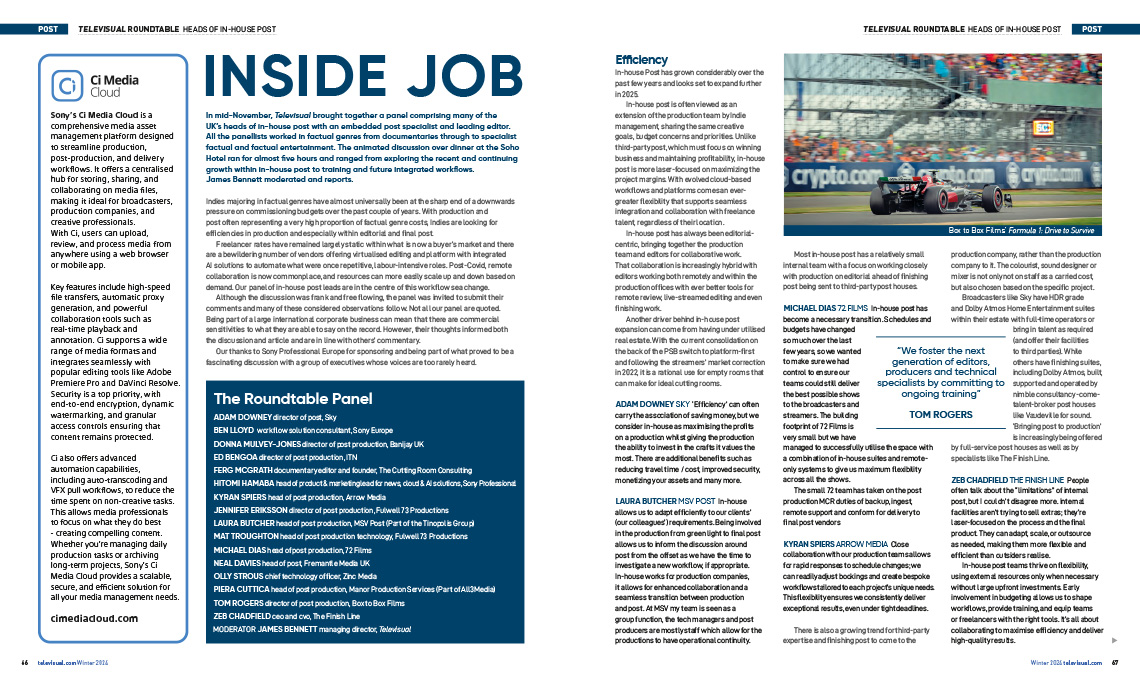
TOM ROGERS – BOX TO BOX FILMS: Box to Box’s productions are always hugely ambitious and global in scale. This leads to challenges in creating an organic workflow, in which directors on location and editors in various locations around the world can stay connected. Our switch to cloud-based editing, with our partner Creative Remote, has ensured that all our creative teams can collaborate in real-time, all contributing to the same Avid projects. We have also dramatically increased the speed with which material is available to the edit – a not insignificant challenge when you consider that Formula 1: Drive to Survive has up to 200TB of offline media per series. Remote viewings with our execs and network commissioners also ensure the notes process on these fast turnaround projects has decreased from days to mere hours and turnover to final post has been streamlined to avoid the endless redeliveries of old.
HITOMI HAMABA – SONY PROFESSIONAL: Efficiency and seamless collaboration are paramount. Utilising a single platform for all aspects of the creative process offers a multitude of advantages that can elevate your team’s productivity and project outcomes.
Envisage a centralized hub where all your digital assets, from videos and images to documents, are readily accessible. No more wasting time searching across multiple directories or tools – everything you require is at your fingertips. This streamlined organisation not only saves valuable time but also minimises the risk of losing crucial files.
However, the benefits extend far beyond resource management. A unified platform fosters real-time collaboration, allowing team members to share feedback, make annotations, and discuss changes instantly, regardless of their physical location. Edits can start seconds after the shot is taken, and by searching AI transcription data, the right shots can be located quickly. This immediacy keeps projects progressing and ensures everyone is on the same page. A single platform simplifies workflows by integrating various tools and functionalities into one intuitive interface. From managing file transfers, to conducting real time review sessions and sharing documents, your team can focus on their tasks without the friction of navigating multiple systems.
Security and compliance are also enhanced, with better control over access permissions and data sharing, ensuring sensitive information remains protected while adhering to brand guidelines and regulatory standards.
In an industry where budgets are often tight, adopting a single platform can lead to significant cost savings by reducing the need for multiple software licences and minimising vendor management complexity.
New tools and AI
And it is not just the workflow that is being looked at for greater efficiencies, but also what applications might be best employed depending on the project and how AI is streamlining and enhancing factual production.
ZEB CHADFIELD – THE FINISH LINE: Recently, we’ve worked with a few production companies shifting editorial to DaVinci Resolve, moving away from rigid Avid workflows. This change has saved tens of thousands of pounds on ingest and conform costs while streamlining post-production workflows. These benefits aren’t possible with external facilities tied to fixed processes. By taking control internally, these teams have achieved greater flexibility, efficiency, quality and cost savings, proving the value of challenging the status quo.
FERG MCGRATH – THE CUTTING ROOM: Dull but transformational is auto-transcription and text-based editing. Transcripts are generated without leaving the NLE and allow sync assembly via transcripts. Auto subtitling also saves time and hassle for the editor or assistant. Re-versioning video aspect ratios for social media can now be a button push. And dialogue audio enhancement is much improved.
With Adobe, amazingly you can now make fake sets. Combine Photshop’s Generative Fill tool with Premiere Pro for an additional wide angle in master interview set-ups. Adobe’s (beta) Generative extend tool can add up to two seconds to the end of a clip…with mixed results!
And with version 11, Apple Final Cut Pro is again on my radar with Impressive rotoscope and object tracking tools. Create Stereoscopic 3D from a single video layer (and watch back on the Vision Pro).
Avid’s innovation has been their cloud-based media management platform, with AI-powered descriptive search and the option for rules-based workflows for processing media and Microsoft Teams Chat integration.
Blackmagic Davinci Resolve super-scales HD to 4k or 8k with intelligent object removal, Intelligent tracking. Face Refinement can remove so-called blemishes like pimples, wrinkles, bags under the eyes and facial shine. Any ethical questions there?