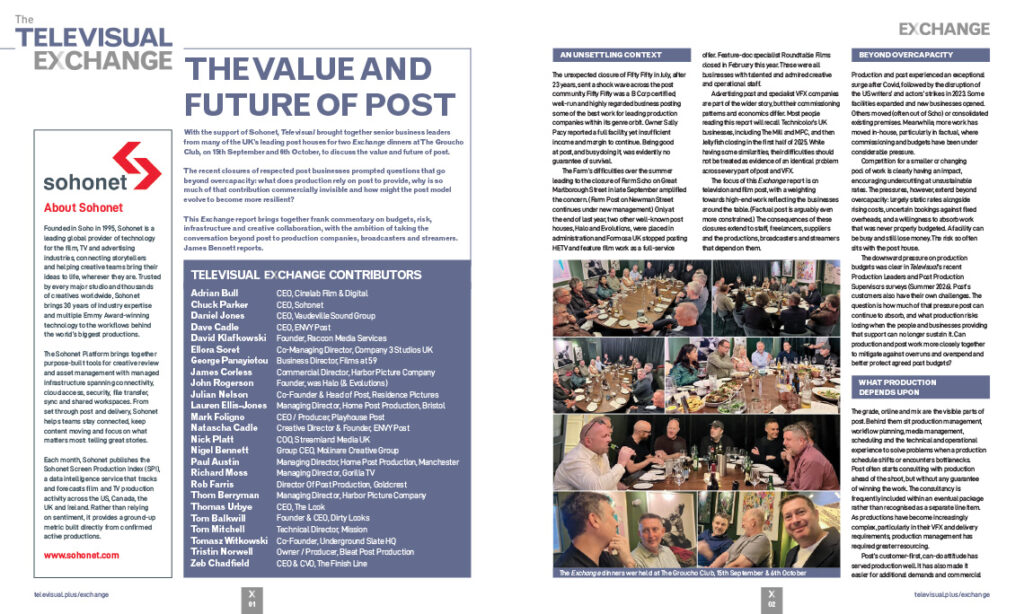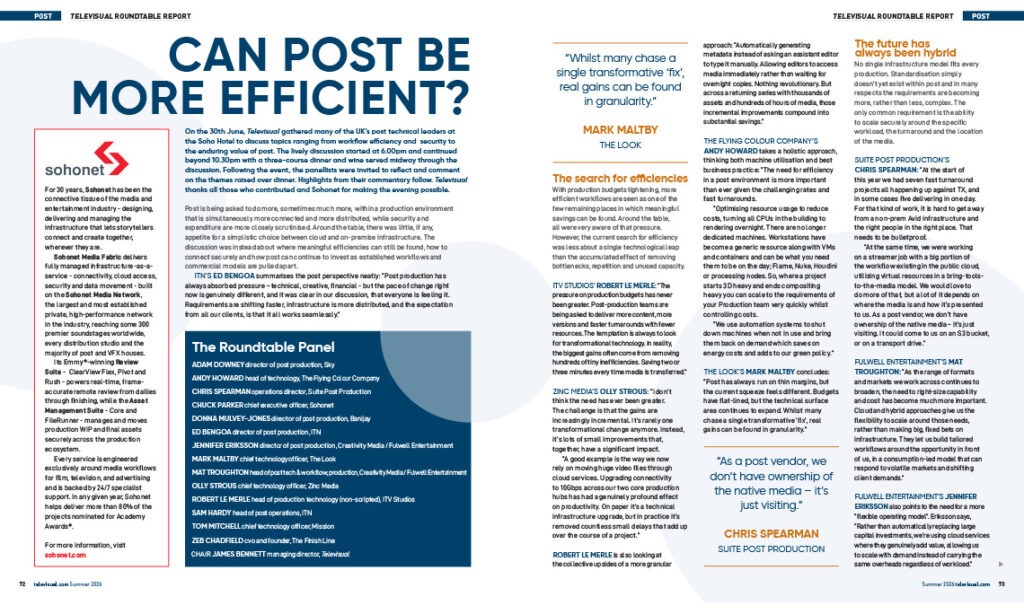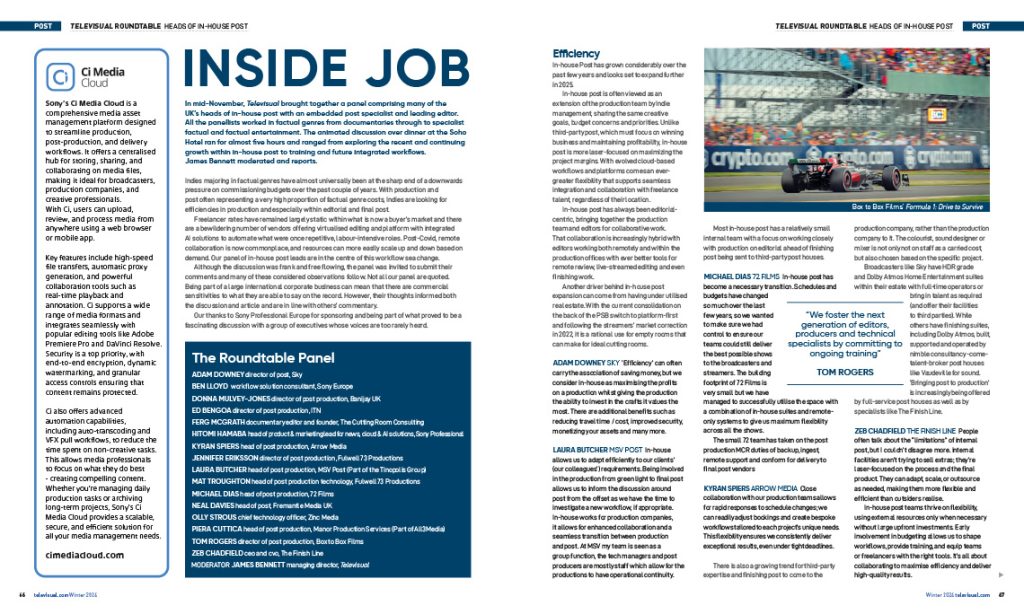

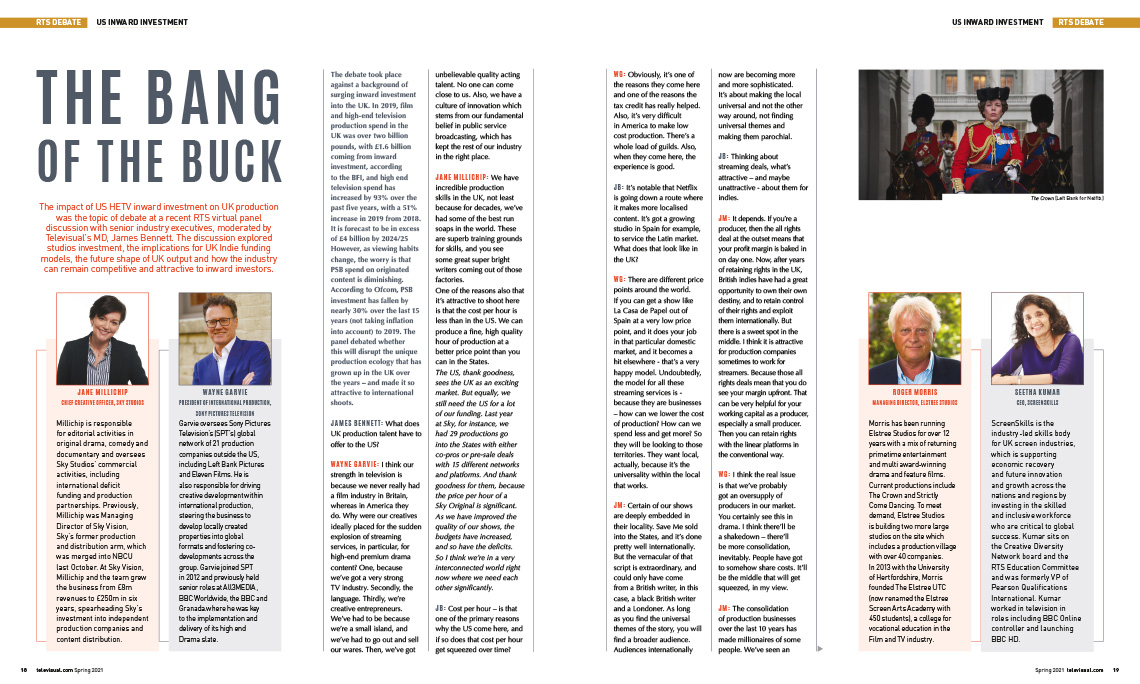
The impact of US HETV inward investment on UK production was the topic of debate at a recent RTS virtual panel discussion with senior industry executives, moderated by Televisual’s MD, James Bennett. The discussion explored studios investment, the implications for UK Indie funding models, the future shape of UK output and how the industry can remain competitive and attractive to inward investors.
The debate took place against a background of surging inward investment into the UK. In 2019, film and high-end television production spend in the UK was over two billion pounds, with £1.6 billion coming from inward investment, according to the BFI, and high end television spend has increased by 93% over the past five years, with a 51% increase in 2019 from 2018. It is forecast to be in excess of £4 billion by 2024/25
However, as viewing habits change, the worry is that PSB spend on originated content is diminishing. According to Ofcom, PSB investment has fallen by nearly 30% over the last 15 years (not taking inflation into account) to 2019. The panel debated whether this will disrupt the unique production ecology that has grown up in the UK over the years – and made it so attractive to international shoots.
James Bennett: What does UK production talent have to offer to the US?
Wayne Garvie: I think our strength in television is because we never really had a film industry in Britain, whereas in America they do. Why were our creatives ideally placed for the sudden explosion of streaming services, in particular, for high-end premium drama content? One, because we’ve got a very strong TV industry. Secondly, the language. Thirdly, we’re creative entrepreneurs. We’ve had to be because we’re a small island, and we’ve had to go out and sell our wares. Then, we’ve got unbelievable quality acting talent. No one can come close to us. Also, we have a culture of innovation which stems from our fundamental belief in public service broadcasting, which has kept the rest of our industry in the right place.
Jane Millichip: We have incredible production skills in the UK, not least because for decades, we’ve had some of the best run soaps in the world. These are superb training grounds for skills, and you see some great super bright writers coming out of those factories.
One of the reasons also that it’s attractive to shoot here is that the cost per hour is less than in the US. We can produce a fine, high quality hour of production at a better price point than you can in the States.
The US, thank goodness, sees the UK as an exciting market. But equally, we still need the US for a lot of our funding. Last year at Sky, for instance, we had 29 productions go into the States with either co-pros or pre-sale deals with 15 different networks and platforms. And thank goodness for them, because the price per hour of a Sky Original is significant. As we have improved the quality of our shows, the budgets have increased, and so have the deficits. So I think we’re in a very interconnected world right now where we need each other significantly.
JB: Cost per hour – is that one of the primary reasons why the US come here, and if so does that cost per hour get squeezed over time?
WG: Obviously, it’s one of the reasons they come here and one of the reasons the tax credit has really helped. Also, it’s very difficult in America to make low cost production. There’s a whole load of guilds. Also, when they come here, the experience is good.
JB: It’s notable that Netflix is going down a route where it makes more localised content. It’s got a growing studio in Spain for example, to service the Latin market. What does that look like in the UK?
WG: There are different price points around the world. If you can get a show like La Casa de Papel out of Spain at a very low price point, and it does your job in that particular domestic market, and it becomes a hit elsewhere – that’s a very happy model. Undoubtedly, the model for all these streaming services is – because they are businesses – how can we lower the cost of production? How can we spend less and get more? So they will be looking to those territories. They want local, actually, because it’s the universality within the local that works.
JM: Certain of our shows are deeply embedded in their locality. Save Me sold into the States, and it’s done pretty well internationally. But the vernacular of that script is extraordinary, and could only have come from a British writer, in this case, a black British writer and a Londoner. As long as you find the universal themes of the story, you will find a broader audience. Audiences internationally now are becoming more and more sophisticated. It’s about making the local universal and not the other way around, not finding universal themes and making them parochial.
JB: Thinking about streaming deals, what’s attractive – and maybe unattractive – about them for indies.
JM: It depends. If you’re a producer, then the all rights deal at the outset means that your profit margin is baked in on day one. Now, after years of retaining rights in the UK, British indies have had a great opportunity to own their own destiny, and to retain control of their rights and exploit them internationally. But there is a sweet spot in the middle. I think it is attractive for production companies sometimes to work for streamers. Because those all rights deals mean that you do see your margin upfront. That can be very helpful for your working capital as a producer, especially a small producer. Then you can retain rights with the linear platforms in the conventional way.
WG: I think the real issue is that we’ve probably got an oversupply of producers in our market. You certainly see this in drama. I think there’ll be a shakedown – there’ll be more consolidation, inevitably. People have got to somehow share costs. It’ll be the middle that will get squeezed, in my view.
JM: The consolidation of production businesses over the last 10 years has made millionaires of some people. We’ve seen an overdue recalibration in the marketplace now. I think that’s what’s happened with the proliferation of Indies. Everybody thought they could flip their company within three years. And then set up again and flip it again. That is running out of steam.
We’ve got into a mindset where a producer feels they can only maximise the cultural, editorial and commercial value of the marketplace if they own their own indie. The fact is that quite a lot of producers are terrible at running businesses, but they’re brilliant at making shows. Not everybody wants to be ordering the loo paper and stationery, and everything else that comes with running an indie. Owning your own company isn’t the only way. Going to a large company like Sony or Sky or the BBC, and getting an inhouse deal, which also enables you to do third party shows, could be exactly what you want.
JB: Why is the strength of our PSB model so important to our future?
JM: I’m a big supporter of the BBC and the licence fee. That’s my personal view. At Sky, we have benefited extraordinarily from the PSB tradition because we have been able to work with the best talent that has been nurtured.
WG: It is important. We’ve got a unique ecology in the UK, which underpins why we’ve been so successful in scripted and unscripted content around the world. I worry that we are in danger of throwing out public service broadcasting for extraordinarily short sighted reasons. A minority of people somehow get more airtime, newspaper time to put their case than they deserve. That will undermine public service broadcasting, and eventually, our ecosystem.
JB:
What is it about the UK that is attractive from a US perspective?
Roger Morris: Inward investment now is driven by tax incentives, and long may that last. Obviously other countries are catching up. You’ve got great tax incentives, for instance, in Hungary, and elsewhere. We have to stay on our toes if we wish to keep this sort business.
Seetha Kumar: I would say it’s the triple pillars of the tax incentives, studios and locations, and then, the workforce. For decades, our creativity in front of and behind the camera has been lauded globally, and has attracted US blockbusters and high-end TV. And then of course, it’s the English language too.
RM: Yes, one of the reasons why the Americans like working here is the language. The dollar-pound relationship is also very, very important. There’s the shopping too! I had one client who wanted to know how far it was to Harvey Nicks. Bear in mind that when top stars come into the UK, they have to be looked after – and they find the UK a great place to work. And by the UK, I mean all four nations. I don’t just mean England.
JB: Also relevant is what happens down the road from Elstree in Soho and Noho, one of the world’s largest network of post companies.
RM: Yes, our VFX industry is fantastic. They’ve been doing great work, and it’s a very important part of our industry. We do need to train up more people to maintain the workflow in the video effects side, which is expanding rapidly.
JB: At last count, there are over 100 studios in planning and development across the UK. Is that sustainable?
RM: There is a huge amount of investment going into new studio builds. We’re spending a fortune at Elstree, building some new stages. And Sky Studios Elstree will be a fantastic complex. The difference with Sky Studios Elstree, which is part of the Comcast group, is that it’s a production studio. It’s like the old Hollywood Studios where they produce their own content. Leavesden is the same, it’s owned by Warner Brothers – it’s a production studio. But a lot of these new studios coming into the market are what I call open market studios, so they’re bookable.
JB: A studio is more than just real estate isn’t – it’s about connectivity and the lot as well.
RM: Yes, at the moment, there’s a number of what I call portable pop up studios going up. They have to bring in infrastructure, whether that’s mobile dressing rooms through to power – everything you would need in a normal production. Remember, you could have 300 or 500 people working there, so you need an infrastructure to support those people.
One of the problems is that the real estate investors currently coming in are not necessarily people from the film and television industry. They are investing in real estate, and they’ve seen the money that has been made in the studio business. But studios are not a business that make a fortune. You increase the value of the land. Ultimately, if you sold the land you could make a lot of money because you’ve increased the value of the land. But the studio business itself is quite a marginal business.
SK: When we think about studio growth, we do need to think about what workforce we need, not just in terms of numbers, but the right volume in certain skilled areas. In our industry, our currency is workforce experience. We do need to think, as we make productions that are more and more ambitious, what is the creativity we need and what is that blend of creative and technology. This goes back to workforce and the skill base. We need that thought through and we can do it. COVID has seen such significant changes in workflow, whether it’s in post production, remote working, or the introduction of virtual production. Mandalorian set the stage, and then there was Netflix’s Midnight Sky. There’s more coming.
JB: How do we nurture UK talent going forward?
SK: You need the entire ecosystem to work together. What’s happening more and more is a convergence of storytelling across the different genres and forms and formats. Whether it’s daytime, where you hone your teeth and experience. I think that ecosystem of scripted, unscripted, children’s, low cost drama, mid cost drama – it is quite difficult to explain to an outsider, but it works. And it fuses and supports each other. Ours has been an utterly disrupted world. If I look at the changes we’ve all seen in our lifetime, whether it’s in business model, or creative technology, it constantly reinvents itself. And I think we need to constantly do that. The key thing is how do we make sure the skills and knowledge are shared.
There’s a lot of change happening, there will be more disruption. There may be companies that collapse, there will be new skills and capabilities needed. If we in the UK want to play our global role, that involves a range and breadth of skills. We need to look forward, to think about the types of things we want to do and work backwards from there in a really disciplined way.
JB: Looking towards the future, ScreenSkills has been working on how to manage the disconnect between education and the needs of the business
SK: In this country, despite all the different things, we come together. It’s very rare to find a body like ours elsewhere. We are entirely led by the industry, and everything we do is informed by the sector. We’re also data driven. For the last couple of years, we have been asking people on the ground, what are the skills you need today? Where do you need support? And how do we support you? Where do we want to place our bets in the future? What is the right skill base, we need? Because we can work in a systematic way to achieve that. We have a lot of work to do across the education pipeline, because there is a chasm that exists between what colleges and universities provide and what the sectors need, partly because our sector is disruptive and is changing rapidly. The education world moves slowly, it has different pulls and pressures. So it’s how do you broker that? And more practically, how do you get much more of a vocational practical induction into this industry? In our industry, you learn through doing.
RM: The PSBs are very important for Elstree Studios. We do a lot of daytime quiz shows and shows like Strictly Come Dancing. It’s not just about drama, it’s about the communication revolution – a lot of modern technology requires different skills.
But the whole thing really is how you make universities and colleges work to our industry requirements. There are new courses out at the moment, the T levels – they are not necessarily appropriate for some of our industry, and the GCSE levels are definitely not necessarily appropriate. We have to pursue it politically. We have to try to make politicians understand what goes on in our world, and to understand the importance of communications.